



District Heating and Cooling
District heating and cooling (DHC) is a network of insulated pipes that delivers heat or cooling from a central low-carbon source to connected buildings, replacing individual gas boilers, oil burners or electric heaters. It is one of the most effective tools available for decarbonising heat in urban areas, town centres and large campuses where buildings are in close proximity.
In North, Central and East Europe, district heating supplies up to 50% of heat demand. In Ireland, the sector is at an early but accelerating stage of development, driven by national climate targets, rising fossil fuel costs and a growing pipeline of feasibility studies and operational networks.
The first large-scale district heating network in Ireland, the Tallaght District Heating Scheme, became operational in 2023, developed by South Dublin County Council in partnership with Codema and operating under Heat Works, Ireland’s first not-for-profit energy utility.
The Case for District Heating in Irish Towns
District heating makes economic and technical sense in areas where heat demand density is sufficient. Town centres, mixed-use development areas, public sector campuses and areas with social housing clusters are typically the best candidates.
Fuel Flexibility
A district heating network can draw heat from multiple sources including heat pumps, biomass, biogas, waste heat from data centres or industrial processes and solar thermal. This flexibility protects connected buildings from price volatility and makes the network progressively cleaner as the energy mix improves.
Lower Running Costs Over Time
Once infrastructure is in place, operating costs are typically lower than individual boiler replacement programmes across many buildings.
Carbon Reduction at Scale
A well-designed network serving a significant number of buildings can deliver much larger carbon reductions than building-by-building retrofit alone.
Eliminating of Individual Boiler Replacement
Connected buildings remove the cost and disruption of periodic boiler replacement and transfer responsibility for heat supply to the network operator.
The Ennis District Heating Project
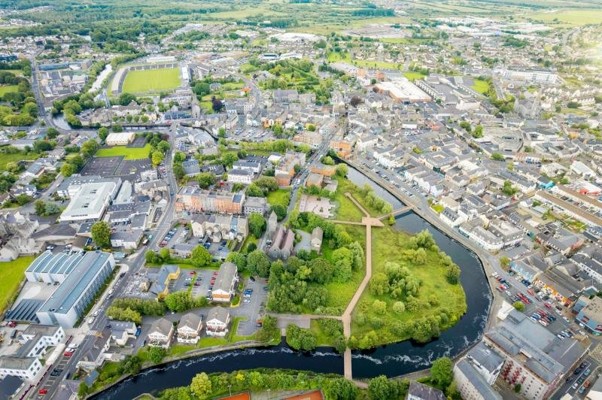
TEA is currently working on the Ennis District Heating project, a feasibility study to develop a concept for a district heating network serving Ennis and its surrounding areas. The study is exploring the potential of waste biomass and other low-carbon heat sources to serve the heating needs of buildings in the town.
Ennis represents a strong candidate for district heating given its compact town centre, mix of public sector, commercial and residential buildings and the presence of potential low-carbon heat sources in the wider area. The project is developing the technical and economic case for a network, identifying priority connection zones and establishing a pathway for implementation.
How TEA Can Support Your District Heating Project
Whether you are a local authority, developer or large energy user, TEA can support you at every stage.
Feasibility Assessment
- Inititial screening to assess whether district heating makes technical and economic sense for your location
- Heat demand mapping to identify building clusters with sufficient demand density
- Low-carbon heat source identification including heat pumps, biomass, biogas and waste heat
- Preliminary network layout and cost estimation
Full Feasibility Study
- Detailed techno-economic feasibility study
- Demand analysis across all potential anchor customers and connected buildings
- Heat source assessment and technology selection
- Network design concept and capital cost estimation
- Business case development including revenue modelling, tariff analysis and financial viability assessment
Project Development
- Stakeholder engagement with potential anchor customers, developers and local authorities
- Governance and ownership structure assessment including local authority ownership models
Funding and Finance
- Identification of relevant national and EU funding for feasibility, development and infrastructure
- Advice on SEAI, DCEE and EU funding applications
Why Tipperary Energy Agency (TEA)
Currently developing the Ennis District Heating feasibility study
Currently developing the Ennis District Heating feasibility study
Collaboration with Codema bringing national best practice to projects
Collaboration with Codema bringing national best practice to projects
25+ years working with local authorities and communities on energy projects in the region
25+ years working with local authorities and communities on energy projects in the region
Interested in Learning More
Contact us!