



Decarbonisation Zones
A Decarbonisation Zone (DZ) is a defined geographic area where a local authority and its community work together to reduce greenhouse gas emissions from everyday activities. The concept was introduced under Ireland’s Climate Action Plan 2021 and is now a statutory requirement for every local authority under the Climate Action and Low Carbon Development (Amendment) Act 2021.
Every local authority must identify a Decarbonisation Zone and include it in their Local Authority Climate Action Plan (LACAP). The zone must cover a population of at least 5,000 people or a land area of at least 5 square kilometres. The objective is to reduce greenhouse gas emissions in the zone by 51% by 2030 based on 2018 levels.
Decarbonisation Zones are intended to be demonstrator areas where innovative approaches to reducing emissions can be tested and, where successful, replicated across the rest of the county and nationally.
The Mid-Tipperary Decarbonisation Zone
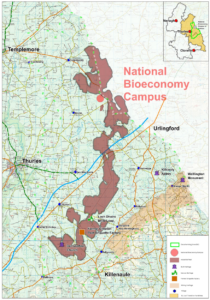
Tipperary County Council has identified the Mid-Tipperary area as its Decarbonisation Zone, centred on the National Bioeconomy Campus at Lisheen. This area falls within the EU Just Transition Fund (JTF) region, which provides additional funding support for communities transitioning away from fossil fuel intensive industries.
The Mid-Tipperary DZ is included in Tipperary County Council’s Local Authority Climate Action Plan 2024-2029, which sets out 100 actions alongside specific opportunity areas and actions for the zone.
Tipperary Energy Agency sits on the Mid-Tipperary Decarbonisation Zone stakeholder committee, contributing technical expertise in energy efficiency, retrofit and renewable energy to help shape the zone’s action programme and support its delivery.
How TEA Can Support Your Decarbonisation Zone
TEA provides end-to-end technical and facilitation support across the full Decarbonisation Zone process.
Baseline Emissions Inventory
- Develop a full Baseline Emissions Inventory (BEI) for your zone across all sectors
- Calculate emissions from buildings, transport, waste and energy use
- Establish the baseline from which progress is tracked and reported
Stakeholder Engagement
- Map all relevant stakeholders within the zone including businesses, community groups and state agencies
- Facilitate stakeholder workshops and community engagement events
- Build local buy-in and shared ownership of the zone action programme
Energy Master Planning
- Develop a zone-level Energy Master Plan identifying priority opportunities
- Assess renewable energy potential including solar, heat pumps and district heating
- Model emission reduction scenarios to identify the most cost-effective pathway to 2030 targets
Project Development
- Assess the technical and economic feasibility of priority projects
- Develop projects to a stage ready for funding application and procurement
- Prepare grant applications for SEAI, EU Just Transition Fund, CARO and other funding bodies
Implementation Support
- Support project delivery including procurement, contractor management and quality assurance
- Provide monitoring and verification of achieved energy and carbon savings
- Prepare progress reporting inputs for the annual LACAP progress report
What a Decarbonisation Zone Programme Involves
Baseline Emissions Inventory
A snapshot of current greenhouse gas emissions in the zone across all sectors including buildings, transport, waste, land use and energy. The BEI establishes the starting point from which progress is measured.
Stakeholder Mapping and Engagement
Identifying and bringing together the businesses, community groups, residents, state agencies and local authority departments who have a role in reducing emissions in the zone.
Action Plan Development
Co-creating a specific set of actions for the zone covering energy efficiency, renewable energy, transport, waste, biodiversity and community activation, tailored to the characteristics of the local area.
Project Development and Funding
Developing priority projects in detail, identifying available funding streams including SEAI grants, EU Just Transition Funds, Climate Action Regional Office support and other national and European programmes.
Implementation and Monitoring
Delivering projects, tracking progress against the Baseline Emissions Inventory and reporting annually through the local authority’s LACAP progress report.
Why Tipperary Energy Agency (TEA)
TEA sits on the Mid-Tipperary Decarbonisation Zone stakeholder committee
TEA sits on the Mid-Tipperary Decarbonisation Zone stakeholder committee
Over 25 years working with local authorities and communities in Tipperary and nationally
Over 25 years working with local authorities and communities in Tipperary and nationally
Direct experience of SEAI, EU and national funding programmes relevant to DZ projects
Direct experience of SEAI, EU and national funding programmes relevant to DZ projects
Interested in Learning More
Contact us!